Brian Onyango
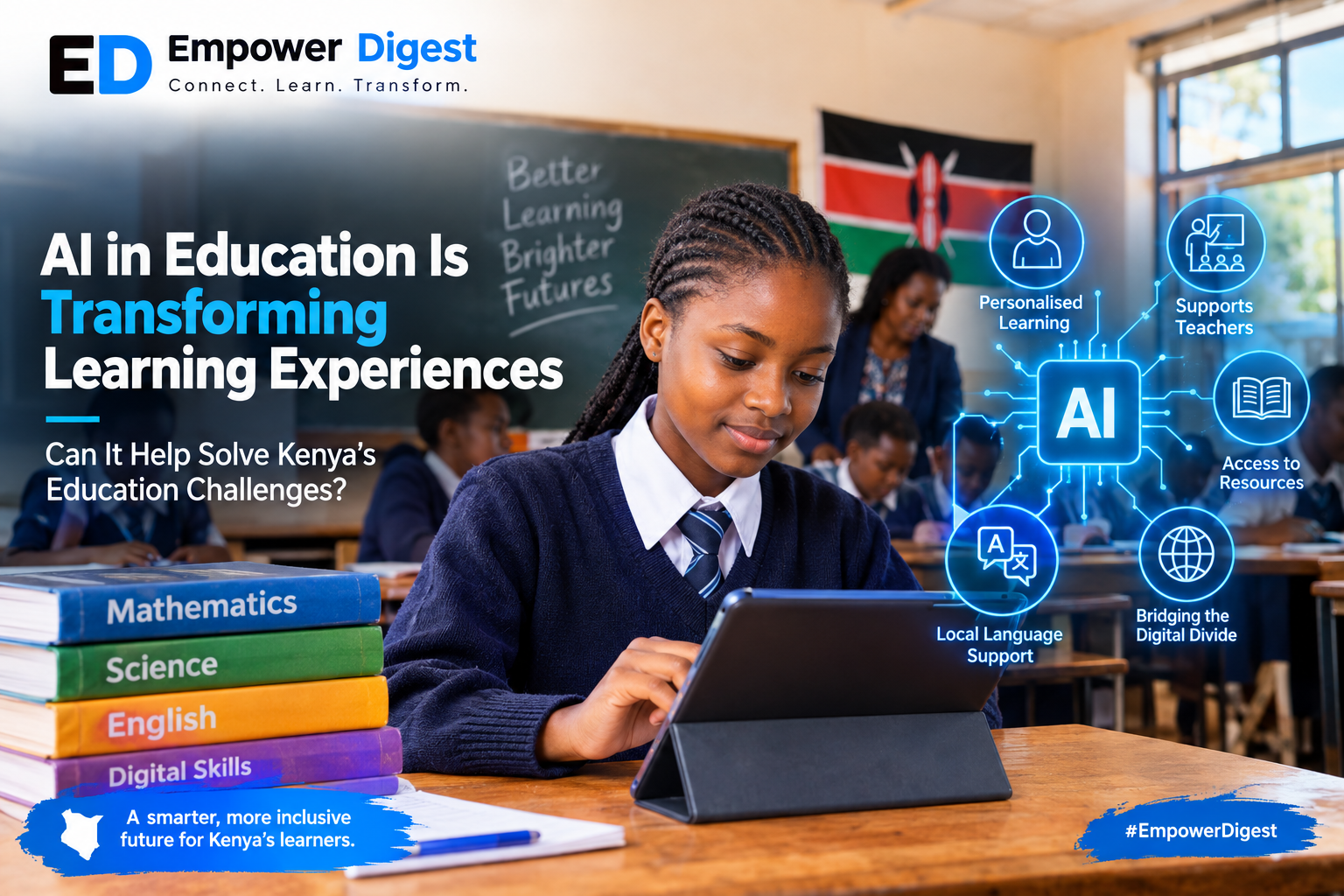
Artificial intelligence (AI) is changing how people learn, work and access information. In education, AI can personalise learning, support teachers, translate content and provide students with educational resources beyond the traditional classroom. For Kenya, this presents an opportunity to address some of the challenges affecting the education sector. From overcrowded classrooms and teacher workloads to unequal access to learning materials and digital resources, AI could become an important tool for improving access and learning outcomes.
However, AI is not a replacement for teachers or a quick fix. Its value will depend on how responsibly and inclusively it is implemented.
Personalised Learning
One of AI’s biggest opportunities is personalised learning.
Students learn at different speeds. One learner may struggle with mathematics while another needs additional support in languages or sciences. AI-powered learning platforms can analyse a student’s performance and provide exercises, explanations and resources based on their individual needs. For Kenyan classrooms where teachers may have large numbers of students, this could provide additional support to learners who might otherwise struggle to receive individual attention.
Supporting Teachers
For Kenyan classrooms where teachers may have large numbers of students, this could provide additional support to learners who might otherwise struggle to receive individual attention.
AI can also help reduce some of the administrative pressure on teachers. Tools can assist with preparing lesson materials, generating practice questions, organizing resources and analyzing student performance. This could allow teachers to spend more time doing what technology cannot replace—mentoring students, encouraging creativity, managing classrooms and understanding individual learners. The objective should therefore be AI supporting teachers, not replacing them.
Reaching Learners Beyond the Classroom
Educational inequality remains closely connected to access to resources. A student in an urban school may have access to computers, libraries, reliable internet and additional academic support, while a learner in a remote or underserved community may have considerably fewer resources. AI-powered learning platforms could help narrow this gap by making educational explanations and practice materials accessible through smartphones, tablets and community learning centres. Kenya’s libraries could also evolve into digital learning hubs where students access computers, internet connectivity and AI-supported educational resources.
The Language Opportunity
AI could also improve access to education through language. Kenya’s diverse linguistic landscape means that technology capable of supporting local languages could make educational content more accessible to learners who may struggle with conventional instructional languages. However, AI-generated translations and explanations must be carefully checked because artificial intelligence can produce inaccurate or misleading information.
The Digital Divide
There is an important warning: AI cannot solve inequality if access to AI itself is unequal. Without affordable internet, electricity, devices and digital skills, the technology could benefit mainly students who are already privileged. Kenya therefore needs investment in digital infrastructure, teacher training, affordable educational platforms, data protection and locally relevant content. Students must also learn how to use AI responsibly; checking information, protecting personal data and developing their own critical-thinking skills rather than simply accepting AI-generated answers.
Kenya’s Opportunity
AI will not solve every problem in Kenya’s education system. But it can become part of a broader strategy to improve access, quality and personalised learning. The future should not be AI versus teachers. It should be AI empowering teachers and learners. A student in Kisumu, Turkana, Garissa or Nairobi should have opportunities to access quality learning support regardless of their location or economic background.
Technology cannot replace the human purpose of education. But used responsibly, it can expand the classroom, strengthen teachers and give more learners access to knowledge. The future of education may not be about replacing the classroom. It may be about expanding what the classroom can reach.
Connect. Learn. Transform.
#EmpowerDigest #AIinEducation #Education #Kenya #ArtificialIntelligence #DigitalLearning #EdTech

 Musa A Odhiambo