Musa A Odhiambo
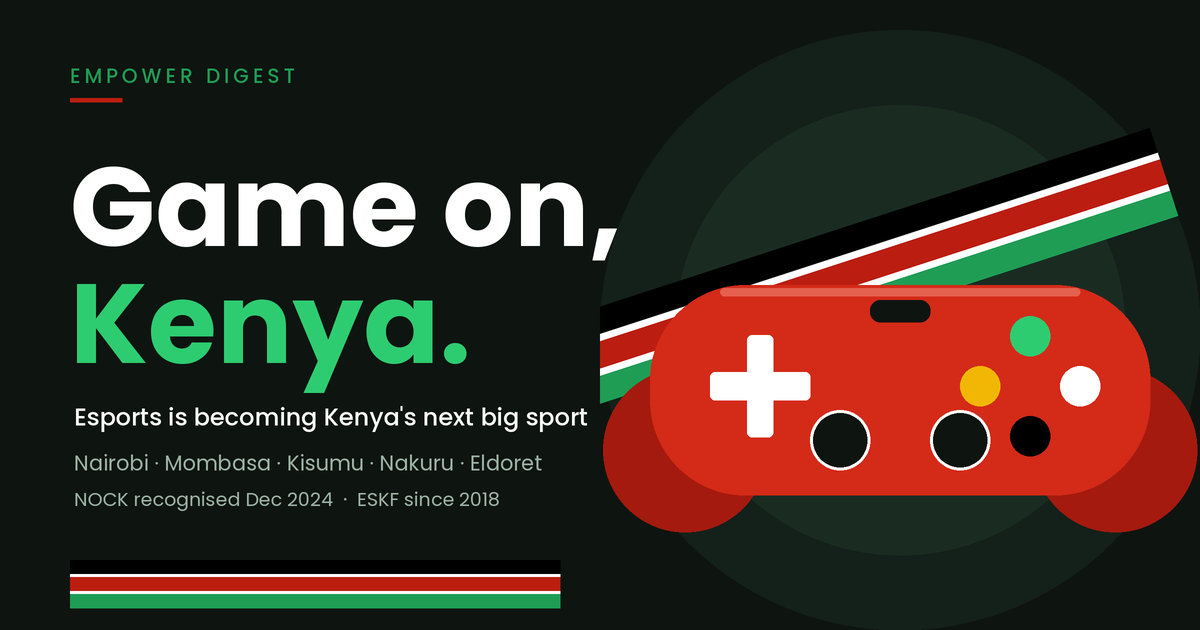
From Kibera to Kisumu, competitive gaming is moving out of bedrooms and into the national spotlight. For years, gaming in Kenya was largely viewed as entertainment—a pastime squeezed between school, work and everyday life. That perception is changing.
Esports, or organised competitive gaming, is developing into a structured sporting and entertainment industry in Kenya, complete with national competitions, professional players, institutional recognition and pathways to international competition. And with Nairobi now positioned to host Africa’s first Global Esports Cup, Kenya’s gaming story is entering a potentially significant new chapter.
From Gaming Hobby to Organised Sport
At the centre of Kenya’s esports development is the Esports Federation Kenya (ESKF). Founded in 2018 and registered under the Sports Registrar within the Ministry of Youth Affairs, Creative Economy and Sports, the federation says it received formal recognition from the National Olympic Committee of Kenya in December 2024. That institutional development matters. Recognition provides a clearer framework for players, teams, tournament organisers and sponsors to build around competitive gaming. It also changes the conversation around gaming: what was once dismissed as simply “playing video games” can increasingly be understood as a competitive discipline requiring training, strategy, teamwork and technical skill. The ecosystem is also becoming more structured, with programmes covering player support, team development and tournament organisation.
Kenya Is Taking Esports Beyond Nairobi
One of the most interesting developments is the effort to take competitive gaming beyond the capital. The Kenya Esports Series 2025 toured Nakuru, Eldoret, Mombasa, Kisumu and Nairobi, giving players outside Nairobi opportunities to compete and qualify for higher-level competitions. The tournament featured games including eFootball, EA FC, Tekken 8, PUBG Mobile, Call of Duty Mobile and Mobile Legends. That matters because talent does not live exclusively in Nairobi. A gamer in Kisumu, Mombasa or Eldoret may have the skill to compete nationally but lack access to major gaming venues, organised tournaments or industry networks. Bringing competitions closer to different communities can help reduce that geographic barrier. Universities and other institutions are also becoming part of the ecosystem, creating spaces where young people can compete, organise teams and develop communities around gaming.
What Are Kenyan Gamers Playing?
Kenya’s competitive gaming scene is diverse. Football titles such as eFootball and EA Sports FC naturally attract attention in a country where football commands a huge following. Fighting games such as Tekken 8 have their own competitive communities, while mobile titles including PUBG Mobile, Call of Duty Mobile and Mobile Legends provide another major entry point. The growth of mobile esports is particularly important.
A high-end gaming PC or console can be expensive. A smartphone, however, is far more accessible to many young people. Mobile gaming therefore lowers one of the barriers to entering competitive gaming. That does not mean the ecosystem is without challenges. Reliable internet, devices, electricity, data costs and suitable gaming spaces can still determine who gets the opportunity to compete.
The Players Putting Kenya on the Map
Every emerging sport needs people who demonstrate what is possible. One of Kenya’s most recognisable esports pioneers is Sylvia “Queen Arrow” Gathoni, a professional fighting-game player known particularly for Tekken Gathoni became the first Kenyan gamer to be signed by an international esports team when she joined US-based XiT Woundz in 2018. She later competed internationally and joined UYU as a content creator. Her career helped demonstrate that Kenyan players could build professional careers beyond the local gaming scene. Her story is also important because women remain underrepresented in competitive gaming.
Another notable figure is Brian “Thee Beast” Diang’a, whose journey from Kibera into competitive gaming illustrates another side of Kenya’s esports story. Diang’a has been involved in mentoring young gamers and promoting gaming communities, showing how esports can become a pathway to community, mentorship and opportunity.
Kenya’s International Moment
The country’s esports ambitions are no longer limited to domestic tournaments. In 2026, Kenya held national qualifiers for the Global Esports Games, with 26 national-team places available across seven titles. The selected players are scheduled to represent Kenya at the Global Esports Games in Los Angeles in December 2026. Kenyan players are already producing results on the international pathway. Martin Kibiwot and Shirley Ndirangu won the men’s Open and women’s eFootball categories at the national qualifiers and earned places at the 2026 Global Esports Games.
Then came another major development. In September 2026, Nairobi was announced as the planned host of the first Global Esports Cup in Africa, following Kenya’s positioning as a strategic esports hub by the Global Esports Federation. If delivered as announced, the event could bring international players, fans, organisers and industry stakeholders to Kenya while creating opportunities across technology, broadcasting, hospitality, tourism and event management.
More Than Players: An Emerging Digital Economy
Perhaps the biggest mistake would be to view esports only through the people holding controllers. A modern esports ecosystem needs much more. It needs coaches, referees, broadcasters, commentators, tournament organisers, content creators, graphic designers, video editors, software developers, event managers, marketers and technology providers. That makes esports part of a much broader digital and creative economy. A successful tournament can involve livestreaming, advertising, sponsorships, venue management, merchandising, hospitality and digital content. For Kenya’s young population, this creates opportunities that extend beyond becoming a professional gamer.
The Challenges Are Still Real
The growth of esports does not mean the industry has already solved its biggest problems. Equipment can be expensive. Internet connectivity and data costs can affect participation. Prize money and sponsorship opportunities remain uneven, while many players still struggle to turn competitive success into stable income. There is also the question of responsible gaming. As esports becomes more professional, Kenya will need structures that support player welfare, fair competition, safeguarding, responsible gaming practices and sustainable careers. The objective should not simply be to produce more tournaments. It should be to build an ecosystem where talent can develop into sustainable opportunities.
From Kibera to Kisumu—and Beyond
Kenya’s esports story is no longer confined to bedrooms and gaming cafés. It is appearing in national competitions, universities, international qualifiers and increasingly in conversations about the country’s creative and digital economy. The emergence of players such as Queen Arrow, the expansion of grassroots competitions and Kenya’s participation in global esports events all point to a scene that is becoming more organised and visible. The planned Global Esports Cup in Nairobi could take that visibility even further. But the real test will be what happens beyond the spotlight. Can Kenya build affordable pathways for young gamers? Can talent from Kisumu, Mombasa, Eldoret, Nakuru and informal settlements access the same opportunities as players in Nairobi? Can esports create careers not only for players but for the wider digital workforce?
Those questions will determine how far the industry can go.For a generation growing up with smartphones, fast internet and digital communities, gaming is no longer simply something to do after school.
For some, it is becoming a sport. For others, a career. And for Kenya, it could become another gateway into the digital economy.
Game on.
Empower Digest — Connect. Learn. Transform.